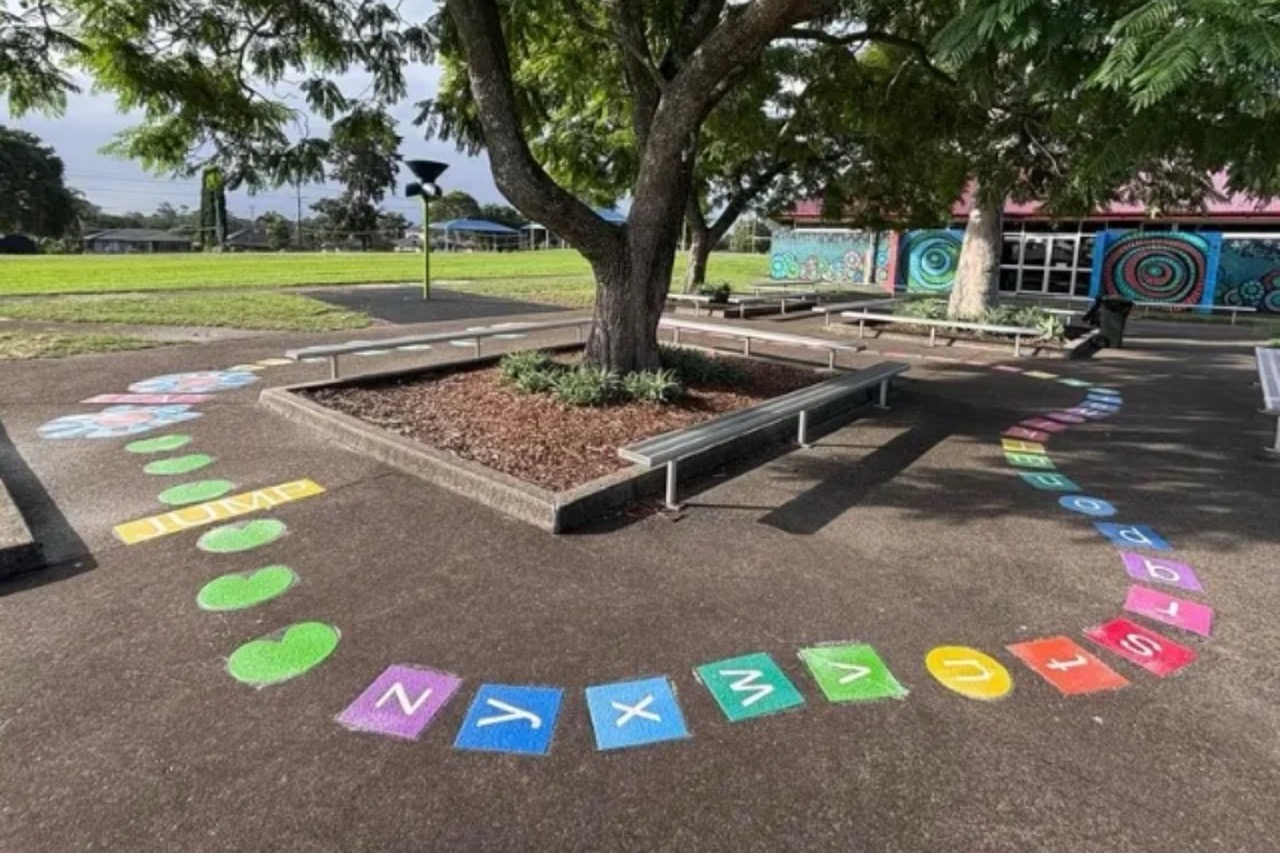
A playground that sits empty during recess is not a design problem. It is a missing structure problem. When Australian primary schools give students clear playground games to play, backed by thermoplastic line markings that define courts and circuits, students self-organise. They move more, conflict less, and make better use of every square metre of grounds.
This guide covers the most popular and effective playground games for primary school students in Australia, the markings that make each game possible, and how to turn your school grounds into a structured, active play environment. EduMarking is Australia’s school line marking specialist, trusted by more than 10,000 schools across Australia and internationally. If you are a principal or school business manager planning a playground upgrade, this is your starting point.
Key Takeaways
- The most-played playground games in Australian primary schools are hopscotch, four square, and running circuits. All of these require thermoplastic line markings to function properly.
- Structured games with clear visual markings reduce unstructured downtime and playground conflict during recess and lunch breaks.
- Thermoplastic line markings last 7 or more years under normal school use. Painted alternatives fade within 12 to 18 months.
- Game markings support ACARA’s cross-curriculum priorities for physical health and active participation.
- The right combination of game zones can transform a single asphalt area into multiple simultaneous play environments.
Why Playground Games Matter for Australian Primary Schools
The Australian Curriculum, Assessment and Reporting Authority (ACARA) identifies physical and personal wellbeing as a core cross-curriculum priority. Recess and lunch breaks are not downtime. They are structured opportunities for students to develop gross motor skills, social cooperation, and physical literacy in ways that classroom time cannot replicate.
The challenge for most schools is that unstructured outdoor time defaults to passive behaviour when the environment does not invite active participation. Thermoplastic game markings solve this by turning empty asphalt into purposeful play zones that students understand and use without supervision prompting.
What the research tells Australian schools
Research from the Australian Institute of Health and Welfare (AIHW) consistently shows that fewer than half of Australian children aged 5 to 17 meet the recommended 60 minutes of moderate to vigorous physical activity per day. School playground time is one of the most reliable and accessible opportunities to close that gap, but only if the environment supports active play.
Structured game markings extend active play time by giving students a framework. A four square court does not require a teacher to run the game. A running circuit does not need equipment to be set out. The marking itself is the invitation to play.
The Best Playground Games for Primary School Students
These are the most popular and effective playground games used in Australian primary schools, along with the line markings each requires and the age groups they suit best.
| Game | Marking Required | Best Age Group | Active Play Level |
|---|---|---|---|
| Four Square | Four Square Court | Years 1 to 6 | Moderate to High |
| Hopscotch | Hopscotch Grid | Foundation to Year 3 | Moderate |
| Running Circuit | Track or Circuit Path | Years 2 to 6 | High |
| Snakes and Ladders | Numbered Grid | Foundation to Year 4 | Low to Moderate |
| Alphabet Trail | Alphabet Path | Foundation to Year 2 | Moderate |
| Basketball | Basketball Court Markings | Years 3 to 6 | High |
| Numeracy Trail | Number Grid or Path | Foundation to Year 3 | Moderate |
| Fitness Circuit | Station Markers and Path | Years 3 to 6 | High |
Four square
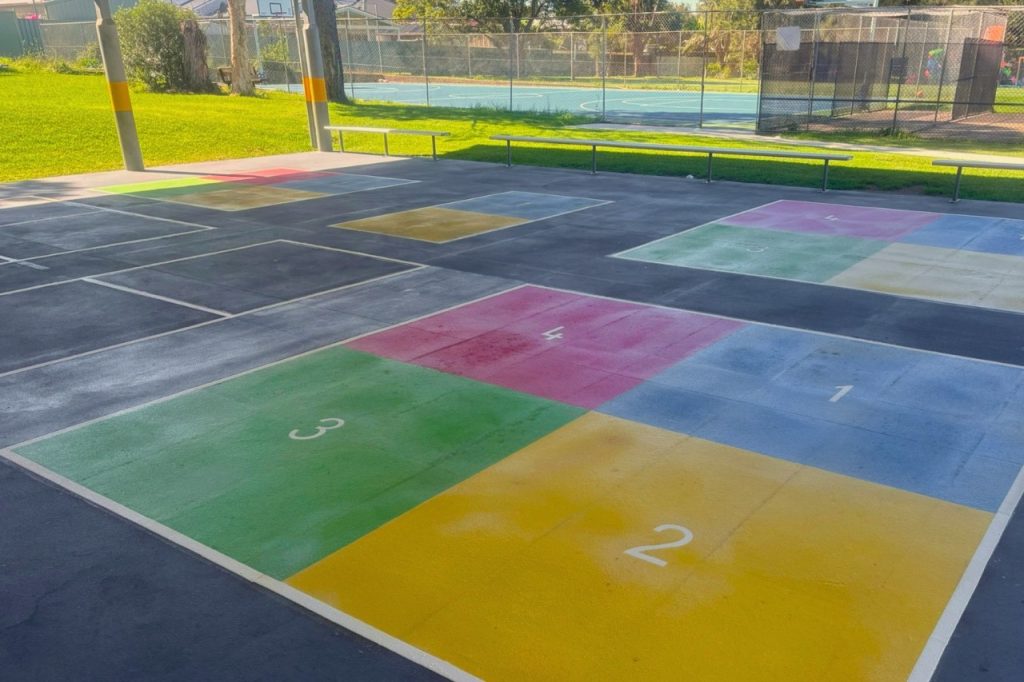
Four square is one of the most widely played games in Australian primary schools and requires no teacher involvement to run. Students form their own games using the court markings as the ruleset. A standard four square court occupies roughly 4 metres by 4 metres and accommodates four players per game, with a queue forming naturally.
Four square develops hand-eye coordination, spatial awareness, and social negotiation skills. It suits all year levels from Foundation through to Year 6 and can run simultaneously across multiple courts on larger grounds.
Four square is one of the most widely played games in Australian primary schools and requires no teacher involvement to run. Students form their own games using the court markings as the ruleset. A standard four square court occupies roughly 4 metres by 4 metres and accommodates four players per game, with a queue forming naturally.
Four square develops hand-eye coordination, spatial awareness, and social negotiation skills. It suits all year levels from Foundation through to Year 6 and can run simultaneously across multiple courts on larger grounds.
Marking requirement
Four Square Court: standard grid with four equal quadrants, typically 4m x 4m, with numbered or labelled squares. Multiple courts can be installed side by side on wider asphalt areas.
Hopscotch
Hopscotch is the most recognised playground marking in Australia and one of the first games primary school students learn to play independently. It builds balance, coordination, and sequential thinking, and is particularly well-suited to Foundation and lower primary year groups.
Thermoplastic hopscotch grids retain their colour and numbering for 7 or more years under normal school use. Painted alternatives fade within a single school year, which means ongoing reapplication costs that thermoplastic avoids entirely.
Marking requirement
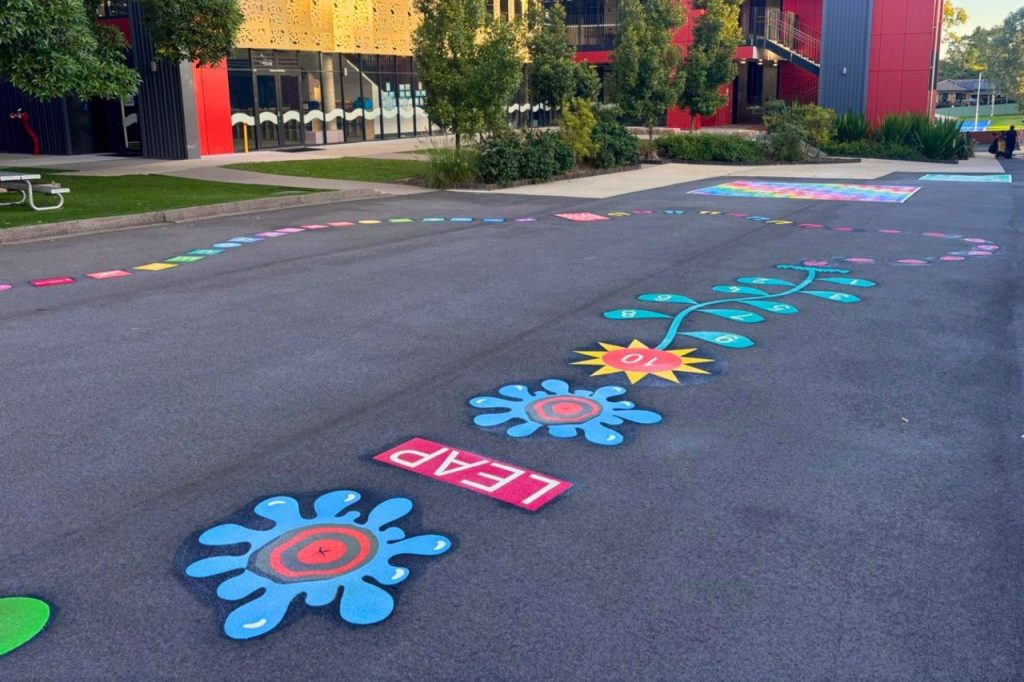
Hopscotch Grid: standard single or double-lane hopscotch numbering from 1 to 10. Custom colour options available to match school brand colours.
Running circuit
A running circuit or fitness track gives students a defined path for active movement during recess and lunch without requiring equipment or supervision to initiate. Circuits can be designed as simple loop tracks or as multi-station fitness courses with activity prompts at each station.
Running circuits align directly with the ACARA Health and Physical Education curriculum by supporting aerobic fitness, cardiovascular health, and sustained physical activity across all year levels. Like all outdoor surfaces, they benefit from a structured playground maintenance program to keep the marking bright and the surface safe over time.
Marking requirement
Circuit Track or Fitness Path: custom designed to fit the available space. Can include station markers, directional arrows, and distance indicators. Suitable for any asphalt or concrete surface.
Snakes and ladders
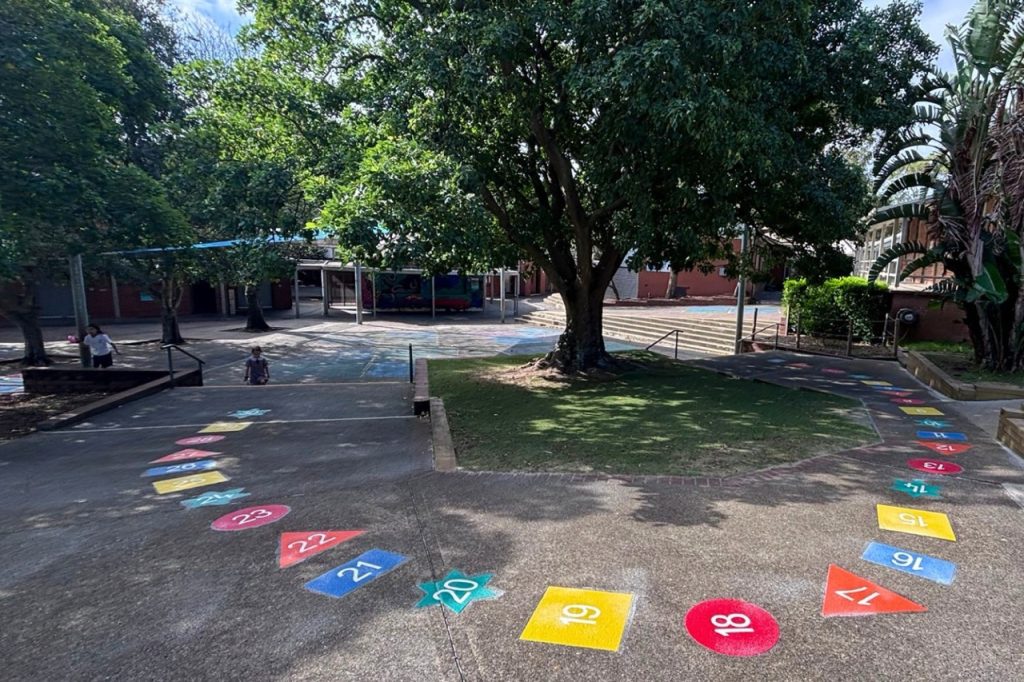
The giant snakes and ladders floor marking is a classroom-to-playground learning crossover that supports numeracy development in an active outdoor context. Students become the game pieces, moving across a numbered grid from 1 to 36 or 1 to 100 depending on the design.
This game is particularly effective for Foundation to Year 4 students and is frequently cited by teachers as one of the markings that sees consistent, high-frequency use long after installation.
Marking requirement
Snakes and Ladders Grid: available in 1 to 36 or 1 to 100 configurations. Each numbered square is clearly marked with the snake and ladder elements incorporated into the design.
Alphabet trail
The alphabet trail is an active literacy tool that turns movement into a learning game. Students hop, jump, or run between letters to spell words, complete teacher-set challenges, or play simple letter-recognition games with classmates.
Alphabet trails are ideal for Foundation to Year 2 play spaces. They bridge outdoor play and classroom curriculum in a way that reinforces letter recognition and early literacy skills without feeling like schoolwork.
Marking requirement
Alphabet Path or Trail: letters A to Z laid out in a walking or jumping trail formation. Can be combined with a numeracy trail on the same surface.
Basketball and sport court markings
Basketball court markings are one of the most-requested sport markings in Australian primary schools. A standard half-court design can be installed on most school asphalt areas and supports both structured sport during PE and informal shooting games during recess.
Multi-use court designs combine basketball, netball, and tennis markings on a single court surface, maximising the use of limited outdoor space. EduMarking installs sport court markings as a standalone service or as part of a broader playground line marking project.
Marking requirement
Basketball Court Markings: half court or full court, with key, three-point arc, free throw line, and centre circle. Multi-use overlays available for netball and tennis.
Does your school playground have the markings to run these games?
- EduMarking installs thermoplastic playground line markings across Australia, backed by a 5-year warranty and 7-year performance guarantee. Most schools have their markings installed during school holidays with zero disruption to the school day.
How to Choose the Right Playground Games for Your School
The right combination of playground game markings depends on three factors: the age range of your student population, the size and configuration of your available outdoor surfaces, and your school’s curriculum priorities.
Match markings to your year level mix
Foundation to Year 2 students benefit most from imaginative and educational markings: hopscotch, alphabet trails, snakes and ladders, and animal shapes that invite open-ended play. Year 3 to Year 6 students engage more consistently with competitive and active markings: four square courts, basketball markings, running circuits, and fitness stations.
Schools with wide year level ranges benefit from zoning their playground into age-appropriate sections, using different marking styles to signal the intended use of each area visually.
Use your surface space strategically
Most Australian primary schools have more asphalt than they realise. A standard four square court takes 16 square metres. A hopscotch grid takes approximately 3 square metres. A full alphabet trail can be installed in a long narrow corridor that currently sits unused. Where the existing surface is cracked or deteriorated, concrete resurfacing before marking gives the thermoplastic the sound base it needs to reach its full lifespan.
EduMarking’s design team provides AI-assisted layout plans within 24 hours of a site visit, showing exactly how multiple game markings can coexist on your existing surface without overlap or crowding.
Align games with your PE and curriculum goals
Playground markings that link to curriculum content, such as alphabet trails, numeracy grids, and literacy paths, extend the school day beyond the classroom in a way that parents, P&C committees, and governing bodies can see and value. For the full range of playground designs available across six categories, including games, educational, fitness, sport courts, custom, and sensory, see our complete design guide.
Schools building out their outdoor learning zones can also combine game markings with structured outdoor seating areas to create defined zones that support both active play and quiet learning in the same grounds.
Thermoplastic vs Paint: Why the Material Matters for Playground Games
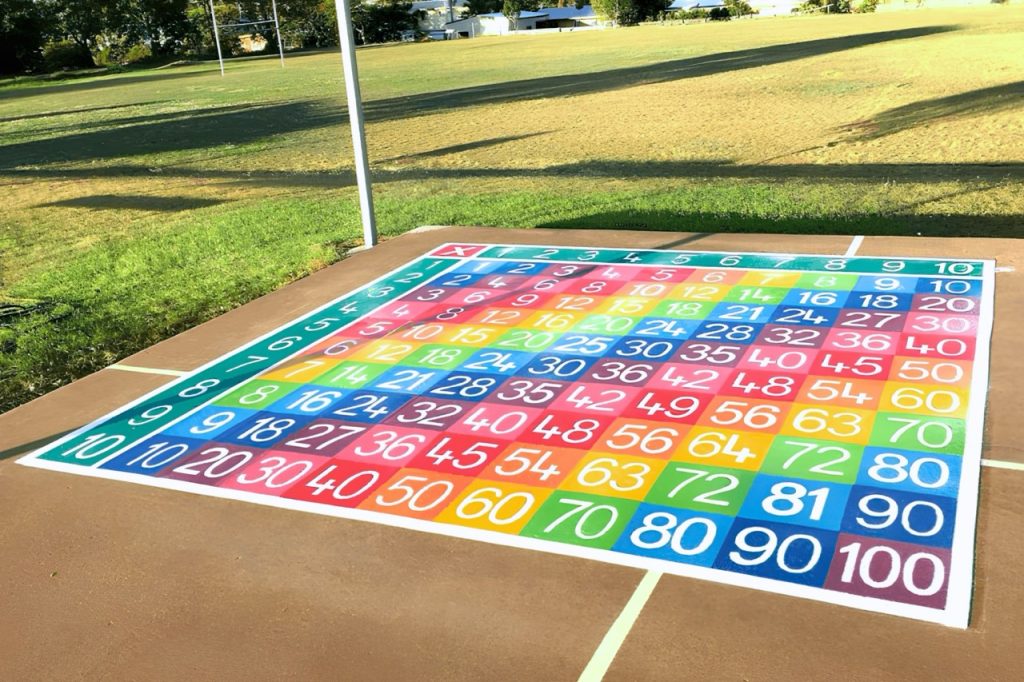
School principals and business managers frequently ask whether paint is a viable alternative to thermoplastic for playground game markings. The short answer is no. Thermoplastic line marking uses the same material class applied to Australian roads and highways: it fuses into the substrate at high temperature rather than forming a film on top like paint, which is why it outlasts paint by a factor of five or more under identical conditions.
| Factor | Thermoplastic | Paint |
|---|---|---|
| Lifespan | 7 or more years under normal school use | 12 to 18 months before fading |
| Warranty | 5-year product warranty | No warranty standard |
| Slip resistance | Non-slip texture in wet and dry conditions | Can become slippery when wet |
| UV performance | UV resistant and retains colour | Fades significantly in Australian sun |
| Long-term cost | Lower: no reapplication required | Higher: requires regular reapplication |
| Compliance | AS 4685-1-2021 compliant | Non-specific standard compliance |
Thermoplastic playground markings are the industry standard for school environments because they perform like infrastructure rather than cosmetics. They are applied using the same material class used in road marking, which is why they hold up to the daily foot traffic of hundreds of students year after year.
Frequently Asked Questions
Australian primary school playgrounds support a wide range of games depending on the markings available. The most popular include four square, hopscotch, running circuits, snakes and ladders, alphabet trails, basketball, and fitness stations. Thermoplastic line markings define the rules and boundaries for each game, allowing students to self-organise without teacher supervision.
Four square is widely regarded as the most popular playground game in Australian primary schools. It requires only a four square court marking and a ball, accommodates four players per game with a queue, and is self-regulating: students manage the rules and rotation without adult intervention. Hopscotch is the most popular option among Foundation and Year 1 to 2 students.
The best no-equipment outdoor games for schools are those built around line markings rather than props. Four square with a ball, running circuits, hopscotch, alphabet trails, and numeracy grids all require only the marking itself to play. This reduces the logistical burden on teachers and ensures games are accessible to all students at any time during the school day.
Thermoplastic playground game markings installed by EduMarking are warranted for 5 years and typically perform for 7 or more years under normal school use. Painted game markings fade within 12 to 18 months and become difficult to read, which reduces student engagement. The long lifespan of thermoplastic makes it the most cost-effective option for school grounds over a 10-year planning horizon.
Yes. EduMarking schedules most installations during school holidays or weekend windows to minimise disruption to school operations. Most standard playground game marking projects are completed within one to two days. For schools that cannot schedule during holidays, works can be staged across after-school hours in coordination with the school’s facilities team.
Ready to give your students games worth playing?
EduMarking designs and installs thermoplastic playground line markings across Australia. From four square courts to full custom designs, we turn your existing asphalt into a structured, active play environment. All installations are backed by a 5-year product warranty.