Most early childhood centre directors can articulate their play based learning philosophy clearly. Fewer have made the connection between that philosophy and the physical design of their outdoor playground.
Australia’s EYLF is explicit: the physical environment is a pedagogical tool. An outdoor area designed around play based learning principles communicates something entirely different to one built around fixed equipment and bare asphalt.
This guide connects play based learning theory to practical outdoor design decisions for Australian early childhood centres. It covers the EYLF position on outdoor play, how theory maps to outdoor features, and what directors should prioritise.
Key Takeaways
- Australia’s EYLF explicitly identifies the physical outdoor environment as a pedagogical tool. In other words, outdoor design decisions are curriculum decisions.
- The five elements of play based learning: child-led exploration, intentional teaching, holistic development, active engagement, and social interaction. Each has direct physical environment requirements.
- Moreover, open-ended, multi-use outdoor spaces that invite child-directed exploration consistently outperform fixed-function equipment in supporting play based learning outcomes.
- Outdoor musical instruments, sensory markings, and defined movement areas are the outdoor elements most aligned with EYLF play based learning principles.
- Centres that design outdoor spaces around play based learning principles report higher engagement, fewer behavioural incidents, and stronger outcomes across all EYLF learning areas.
- EduMarking is Australia’s school line marking and outdoor environment specialist. More than 10,000 schools and early childhood centres across Australia trust us to design outdoor spaces that support active learning every day.
What the EYLF Says About Play Based Learning and Outdoor Environments

The EYLF, published by the Australian Government and administered by ACECQA, combines play-based learning and intentional teaching into one integrated practice. This is a significant shift from the previous version, which treated them separately. The updated framework reflects the evidence that child-initiated play and educator intentionality are not opposing approaches: they are complementary.
The EYLF identifies the design of learning environments, both indoor and outdoor, as a core educator practice. According to ACECQA’s information sheet on play-based learning and intentionality, educators are expected to deliberately decide which experiences, materials, and spaces are available.
For outdoor playgrounds, this means every element of the physical space is a pedagogical decision. In practice, the question is not whether your outdoor environment teaches: it does, every day. However, the more important question is whether it is designed to teach what your curriculum intentions say it should.
The five EYLF learning outcomes and outdoor environments
Specifically, the five EYLF learning outcomes provide a clear map for outdoor environment design. Each outcome has direct physical environment implications that go beyond generic play structures.
The table below maps each outcome to its outdoor environment implication for early childhood centres.
| # | EYLF Learning Outcome | What This Means for Children | Outdoor Environment Implication |
|---|---|---|---|
| 1 | Strong sense of identity | Children feel safe, secure, and supported to explore independently | Open-ended spaces without prescribed use; loose parts; low-risk exploration zones |
| 2 | Connected to community | Children develop social skills and cooperative play | Group play zones; musical instruments for collaborative play; shared seating |
| 3 | Wellbeing | Physical activity, self-regulation, and sensory processing | Movement circuits; sensory markings; calming zones adjacent to active areas |
| 4 | Confident learner | Children investigate, problem-solve, and make connections | Multi-use surfaces; creative markings; materials that invite experimentation |
| 5 | Effective communicator | Children express ideas through gesture, play, and sound | Musical instruments; roleplay zones; storytelling areas; yarning circles |
What intentional outdoor design looks like in practice
The NSW Department of Education’s information sheet on play-based learning and intentionality describes intentional teaching as purposeful, strategic decision-making across all curriculum aspects. An intentionally designed space does not leave engagement to chance. It is arranged so that different children, with different interests and developmental stages, find a genuine reason to participate.
In practice, this means zoning the outdoor space so that active movement, sensory engagement, social play, and quiet recovery options exist simultaneously. As a result, no child arrives in the outdoor area and finds nothing that invites their participation.
How Play Based Learning Principles Shape Outdoor Playground Design
Moving from the EYLF framework to actual outdoor design requires translating each play based learning principle into a physical environment decision. The following framework maps each principle directly to its outdoor design implication for early childhood centres.
| Play Based Learning Principle | What It Requires of the Environment | Outdoor Design Response |
|---|---|---|
| Child-led exploration | Unscripted spaces that children can use in multiple ways, without adults directing the play | Open asphalt areas with creative markings; loose parts stations; multi-use surfaces |
| Intentional teaching | Deliberately placed invitations that extend children’s thinking without directing it | Musical instruments that reward experimentation; sensory trails; literacy and numeracy markings |
| Holistic development | Simultaneous access to physical, cognitive, social, emotional, and sensory experiences | Zoned outdoor areas with distinct movement, sensory, social, and quiet functions |
| Active engagement | Physical materials and spaces that invite doing, not watching | Running circuits; climbing elements; interactive panels; textured surfaces |
The problem with fixed-function outdoor equipment
Fixed-function outdoor play equipment, such as a single climbing frame or set of swings, serves a limited and predictable range of play types. However, it tends to dominate the outdoor environment visually while leaving large areas of asphalt unused. This is the opposite of what play based learning environments require.
Furthermore, the EYLF identifies child agency as central to developmental outcomes. Fixed equipment does not invite agency: it prescribes a use and waits for a child to follow it.
Why open-ended environments produce stronger play based learning outcomes
Open-ended outdoor environments consistently outperform fixed-equipment playgrounds on play based learning measures. Consequently, children spend more time engaged, demonstrate more complex social negotiation, and show higher levels of creative and problem-solving behaviour.
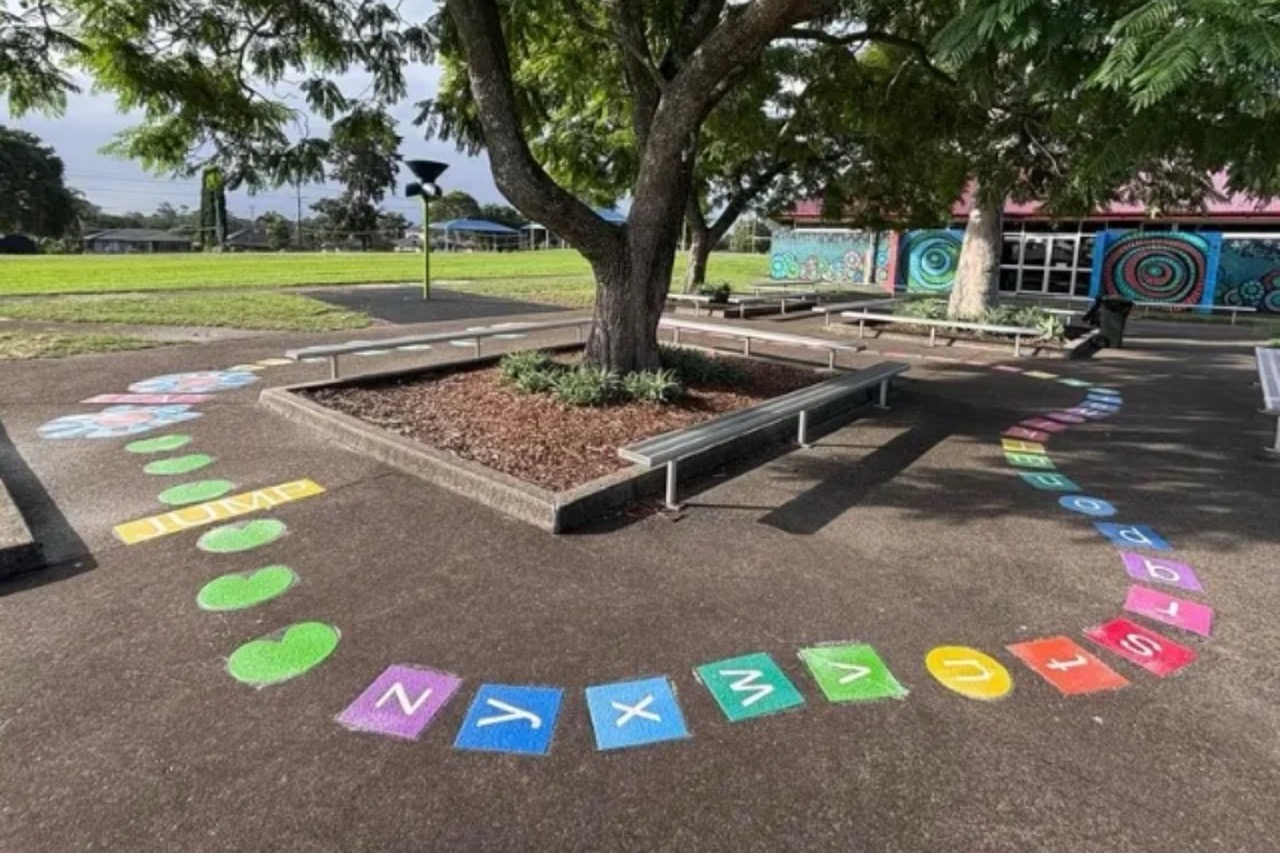
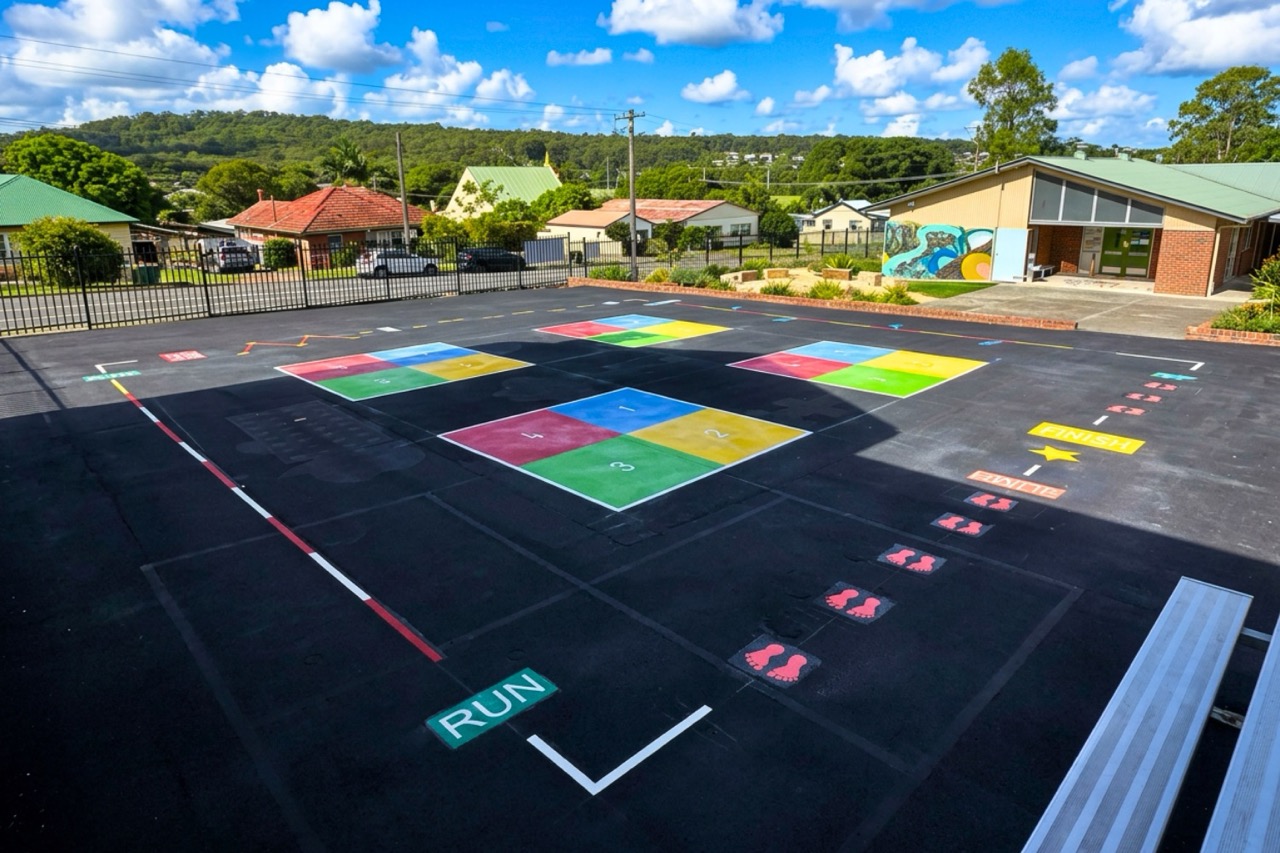
Fortunately, the most cost-effective way to create an open-ended outdoor environment is through thoughtful surface design. Thermoplastic playground line marking can transform bare asphalt into a multi-use play based learning environment. Game zones, sensory trails, and movement circuits are all achievable without structural modification.
Is your outdoor space designed around play based learning?
- EduMarking designs and installs outdoor environments for early childhood centres across Australia, from outdoor musical instruments and sensory markings to movement circuits and seating zones. Every installation is backed by a 5-year product warranty and completed with zero disruption to centre operations.
What to Install in Your Early Childhood Outdoor Environment
Specifically, four outdoor elements consistently produce the strongest play based learning outcomes in Australian early childhood settings. Each activates multiple EYLF learning outcomes simultaneously and supports child-led exploration without requiring adult facilitation.
Outdoor musical instruments
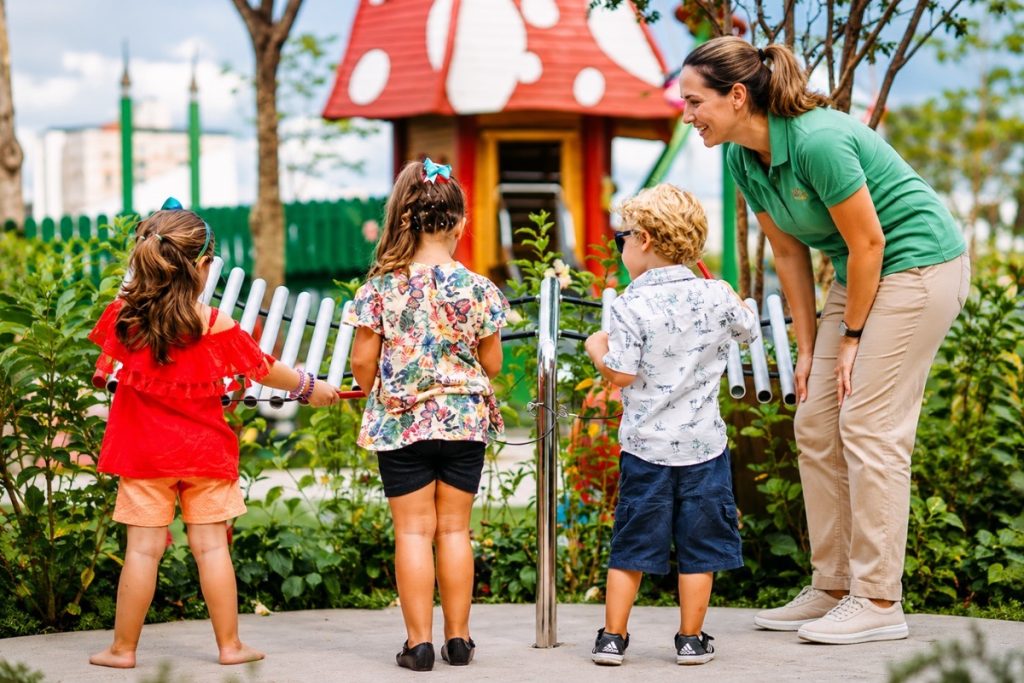
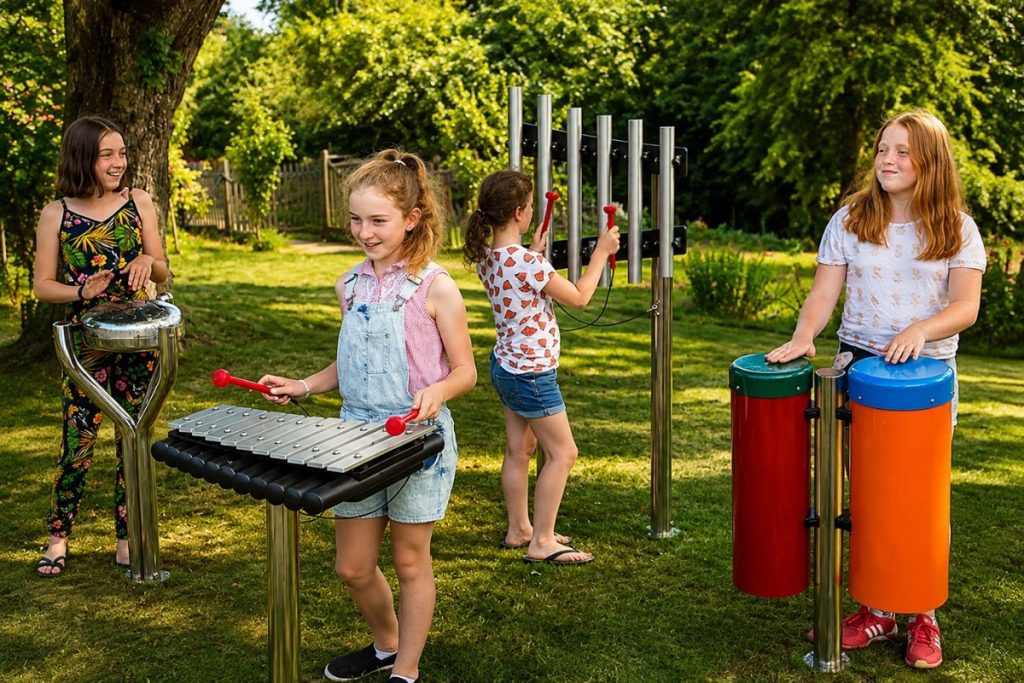
Of all outdoor play elements, outdoor musical instruments are the most versatile tool available for early childhood settings. EduMarking’s outdoor musical instruments range includes marine-grade stainless steel drums, xylophones, chimes, and harmony petals. All are built for Australian conditions and require no maintenance beyond occasional cleaning.
Musical instruments activate EYLF Learning Outcomes 1, 2, 3, and 5 simultaneously. Children develop identity through expression, build peer connections through collaborative play, and develop communication skills through sound. Additionally, they suit all abilities without modification.
EYLF alignment note
- Outdoor musical instruments directly support EYLF Practice: play-based learning with intentionality. Educators can extend children’s learning through deliberately positioned instruments that invite experimentation, collaboration, and creative thinking, without directing the play.
Sensory markings and textured surfaces
Sensory pathway markings, textured surfaces, and colourful ground markings create the visual and tactile invitations that play based learning environments require. Applied as thermoplastic on existing asphalt, they transform bare surfaces into multi-layered early childhood environments. A structured approach to sensory play ideas specific to early childhood outdoor environments is the most practical starting point for centres planning this zone.
In particular, sensory markings support proprioceptive and tactile development for children with sensory processing differences. Additionally, they provide visual wayfinding cues for children with autism spectrum conditions and create invitations for imaginative play across all age groups.
Outdoor seating and structured learning zones
Furthermore, structured outdoor seating transforms open asphalt into identifiable social and learning zones. Outdoor seating areas adjacent to sensory or musical zones create the transitional spaces play based learning environments need. Children can observe before joining, recover between activities, or gather with educators for small-group experiences, without breaking the flow of child-directed play elsewhere.
Yarning circles, tiered seating areas, and shaded group settings create the gathering infrastructure for intentional teaching outdoors. Specifically, this is where the EYLF expects learning to happen most of the time in early childhood settings.
Movement markings and active play circuits
Thermoplastic movement markings, including running circuits, hop-and-jump grids, and balance trails, give children the physical engagement EYLF Learning Outcome 3 requires. That outcome covers wellbeing and physical development across all early childhood age groups.
Unlike fixed equipment, these markings occupy minimal footprint and require no maintenance. The playground games available across age groups include running circuits, jump grids, balance trails, and alphabet paths on existing asphalt.
For early childhood settings specifically, movement markings are particularly valuable for gross motor development in the toddler and preschool age range. Hop-and-jump grids, stepping stone sequences, and directional path markings give children structured movement challenges they can attempt independently and repeat at their own pace.
Frequently Asked Questions
In the EYLF, play based learning with intentionality is defined as a practice where child-initiated play and deliberate educator decisions work together. Notably, the framework combined what were previously two separate practices into one.
This reflects clear evidence that children learn best when their curiosity and self-directed play is supported by a purposeful environment. The outdoor space is central to that.
The play based learning research literature identifies five core elements. These are: child-led exploration, intentional teaching, holistic development, active engagement, and social interaction. Each has direct implications for outdoor environment design.
An effective play based learning environment offers open-ended spaces, sensory elements, defined zones, and transition spaces. For this reason, zone-based design consistently outperforms single-function equipment configurations.
The ACECQA information sheet on play-based learning and intentionality notes that play-based learning with intentionality expands children’s thinking and enhances their desire to learn. The evidence base identifies stronger outcomes across all five developmental domains. These span cognitive, social-emotional, physical, language and communication, and creative development, each activated through movement, peer interaction, open-ended materials, and purposeful play.
Effective outdoor play based learning activities for preschoolers span five categories: percussion instruments, sensory trails, loose parts play, movement markings, and structured games. Each activates a different combination of EYLF learning outcomes.
From EYLF Philosophy to Outdoor Practice
Ultimately, the gap between play based learning as a curriculum philosophy and a lived outdoor experience comes down to physical design. Centres that articulate a play-based approach but maintain bare asphalt and a single climbing frame are not delivering on their own stated intentions.
The physical environment either supports play based learning or it does not. A sound zone, a sensory trail, a movement circuit, and a defined seating area installed on existing asphalt create the conditions the EYLF describes and the outcomes ECEC directors are measured against.
EduMarking designs and installs outdoor musical instruments, sensory markings, movement circuits, and seating zones for early childhood centres across Australia. Every project is delivered with full compliance documentation and installed during centre closure periods. If you are ready to move from philosophy to practice, contact EduMarking to see what is possible on your grounds.